
Teal Eyeshadow and Trust Lessons from Lenora

My favorite hospice patient died over the weekend.
This patient, who I’ll call Lenora, was a spunky lady who had teal eyeshadow tattooed on her eyelids so she’d always look her best, even when confined to a hospital bed! She loved cats and watching the shopping channel on TV, and she had 11 children, most of them “adopted” when others in her community couldn’t care for them.
Lenora and I spent a lot of time talking about her visions of Jesus. She explained that during several occasions of significant illness, Jesus had taken her to view heaven while promising to bring her back so she could continue caring for her family that she loved so much. Lately, though, Lenora had been telling me, “Next time, I think I want to stay.” I should have known her death was imminent, but I wasn’t ready for it to happen so quickly, and without one last visit taking place.
Today I’ve been reflecting on the challenge of getting close to a patient and yet not being the one to tend to her death. At my hospice organization, the care team handles deaths if they happen during the workday but, overnight and on weekends, whoever is on-call completes a death visit, even if they’re from a different geographical territory. So, since Lenora died over a weekend, I didn’t have the opportunity to pray with and for her in her last hours, to recite a litany of gratitude for the medications that managed her pain, or to comfort her family when they saw she had died, all cherished elements of my work with patients at the end of their lives.
In 1 Corinthians 3:6, Paul is recorded as saying “I planted, Apollos watered, but God gave the growth.” He was urging this community not to fight with each other about who their leader was, because ultimately God was the one working in their midst. This passage has given me some comfort as I think about Lenora. I can’t claim to be the one who planted a seed of Jesus’ love in her—pastors and family
members did that long before I became her hospice chaplain—and, ultimately, it was God who gave Lenora the visions that brought her so much comfort. But I do think that I did a fair amount of watering over the past few months, reminding Lenora that Jesus had always kept his promise to “bring her back” to her family and could, therefore, be trusted to keep his promise of welcoming her into heaven when she died.
But, as I continue to think about Lenora in light of this passage, I’ve reflected on another important component: it’s one thing to believe that I’m commending Lenora’s life to God’s care; it’s another thing entirely to hand her over to colleagues that I don’t know (yet), and to believe that they will do right by her when she dies, even if they’re not chaplains and don’t know about or share her faith.
I was recently introduced to the work of Allison Lanza. A Disciples of Christ pastor and non-profit leader, she explains that no person, and indeed no community, can heal all the world’s injustices. Physically, mentally, and emotionally, none of us can do it all. Rather, our job as individuals and communities who care is to figure out what is ours to do—that which combines our giftedness and the world’s needs—and what we need to entrust to the rest of the body of Christ. So, too, with Lenora.
I must live in trust that my colleagues are working in hospice because, like me, they are committed to compassionate end-of- life care and brought their very best selves to Lenora’s death visit. They aren’t likely to do everything the way I would have done it but, frankly, if I were left to do all of the work myself, I wouldn’t be capable of doing everything the way I prefer either! I trust, because I have no other option, that my colleagues’ attentiveness to Lenora’s humanity caused their care to be touched by divinity.
May peace be to Lenora’s memory, and may we all discover the role we are called to play, while trusting that others are called to do the rest.
—
FCM Member Jennifer Pope is a chaplain with Unity Hospice in Chicago, IL.
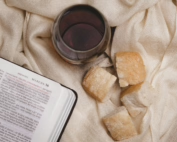





On a dreary Sunday morning, my colleague asked if I would take a case for him. Someone was asking for communion, and because of the denomination he represented, he preferred that someone else do it. I was fine with that. I gathered the elements as well as a hymnal, opened it to the rite of