Communion
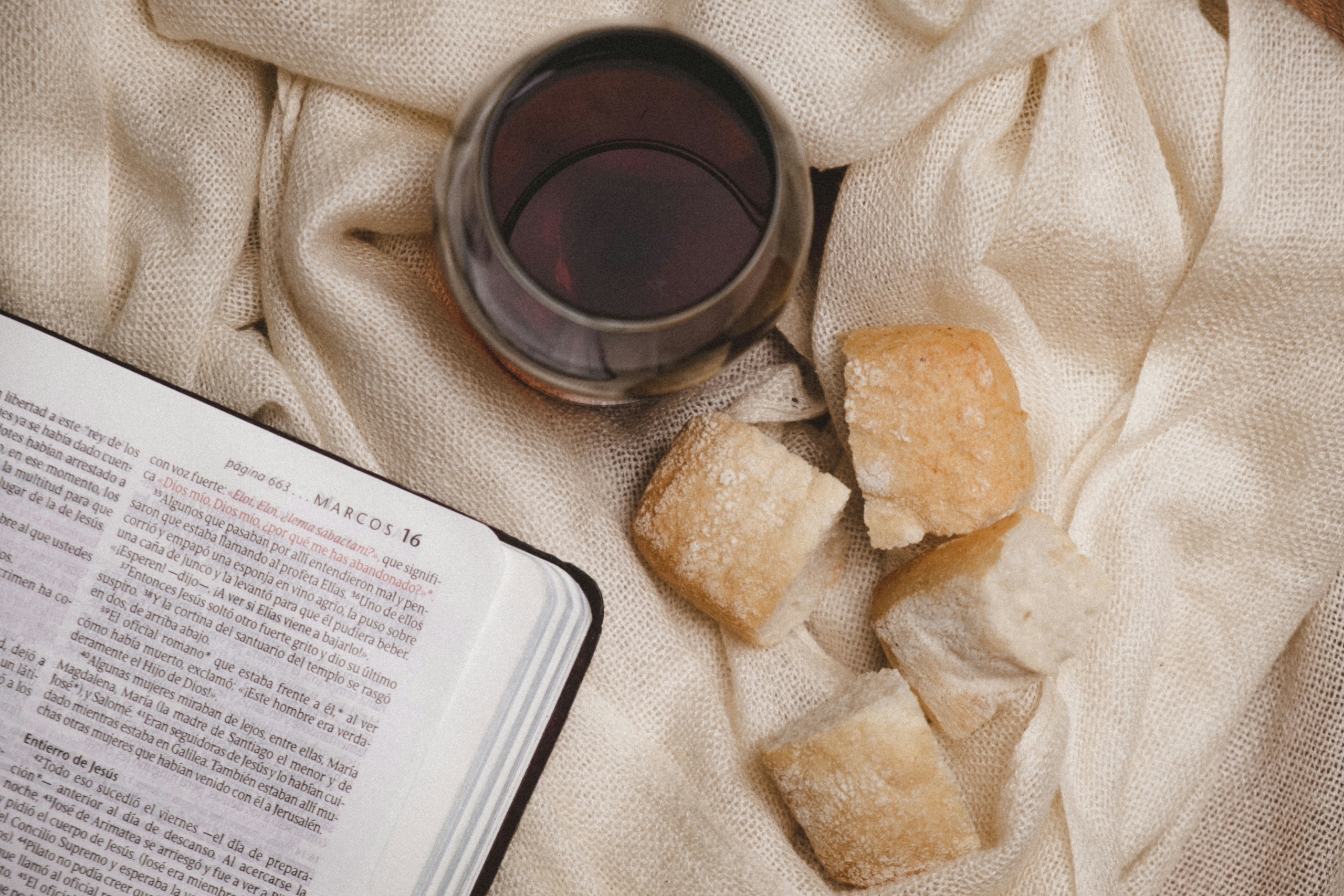
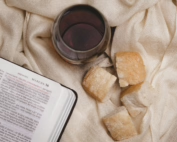
On a dreary Sunday morning, my colleague asked if I would take a case for him. Someone was asking for communion, and because of the denomination he represented, he preferred that someone else do it. I was fine with that. I gathered the elements as well as a hymnal, opened it to the rite of communion and chose the content I would use. It had to be short for this very sick patient. As I made my way to her room,
I prayed a prayer from my own tradition, A Course in Miracles:
“I am here only to be truly helpful. I am here to represent Him who sent me. I do not have to worry about what to say or what to do because He who sent me will direct me. I am content to be wherever He wishes, knowing He goes there with me. I will be healed as I let Him teach me to heal.”
As I approached the room, I saw the tell-tale yellow shoe bag-like container on the door. She was on enteric precautions. I peaked inside to make sure she was awake. I donned the paper gown and put on the gloves which did not fit me well enough for fine motor skills, such as peeling away the thin, tight cover over the wafer on top of the compact set of communion elements. I asked another nurse to open it up for me, which he did. I went inside to find the patient under the covers from the neck down. She was
glad to see me. After we introduced ourselves to one another, and as I set up my book and the elements, I asked her about her religious affiliation. I was stopped in my tracks when she said she was Catholic. My colleague knows that I am not Catholic. I told her that I could arrange for a priest or Eucharistic minister to come the next day if she wished, or I could proceed with communion, but that she needed to know that I am not Catholic. She was emphatic that she wanted me, not the priest. She pulled the sheet down just low enough for me to see her arms and hands, bent inward at the wrists, unable to grasp anything. I proceeded with the ritual, placing the wafer in her mouth and lifting the little cup of juice to her lips. As I was finishing, she suddenly began to talk.
She told me that she has cerebral palsy and that she had an experience in which the priest told her that she could not be a member of the church because she didn’t come enough. She explained that she could not go there. She felt rejected and ashamed, so she left the Catholic church and began attending a Protestant church. I listened intently. When she was done, our eyes met. Full of conviction, I told her that she is a child of God, precious in His sight just like everyone else, deeply loved, and that she should
never let anyone convince her otherwise. It was as if our souls met at that moment. She broke out with a smile and thanked me.
That felt like real communion. The elements were a bridge to bring us together, but Christ’s love, and her realization that she was not left out, was the true communion. I felt so full of the Spirit when I was with her. As I left, I thought, “I will be healed as I let Him teach me to heal.”
—
FCM Member Lois Passi is a part-time chaplain at Geisinger Medical Center in Danville, PA. She attends a UCC church and is also a student of A Course in Miracles.